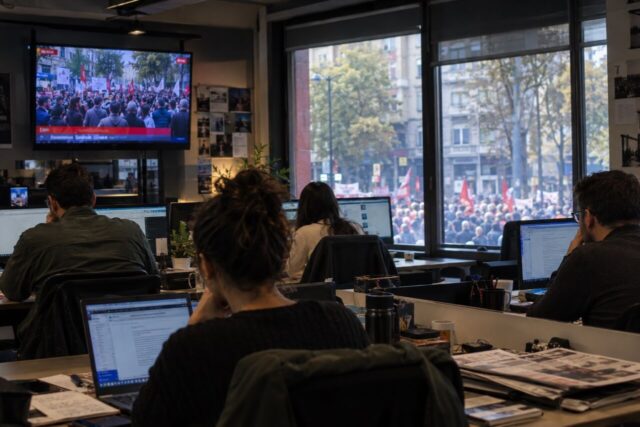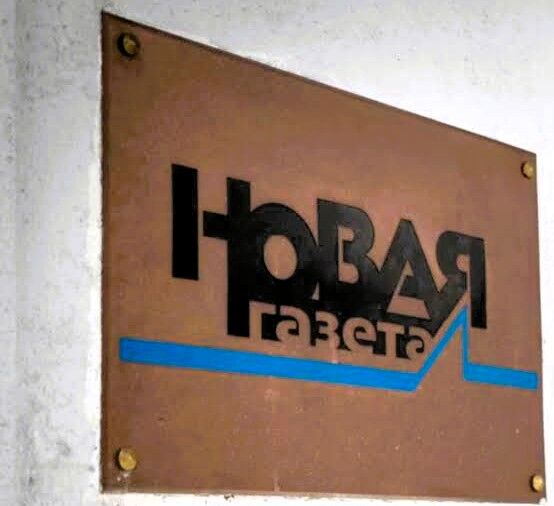
Novaya Gazeta, Russia’s best-known independent newspaper, closed its editorial offices in Moscow on 9 November after 33 years. The newspaper, which lost six staff members to murder, brought the world’s attention to torture in Chechnya and was awarded the Nobel Peace Prize, has finally succumbed to pressure from the Kremlin.
On 30 October, the newspaper announced its closure in a statement titled “They Have Killed Us”: “We will be turning off the lights in the home we have lived in for 30 years.” Novaya had remained the last major independent media outlet in Russia to criticise the Kremlin after other independent publications were shut down in 2022.
SEVEN MONTHS LEADING UP TO THE CLOSURE
The final blows came within seven months. In April, the editorial offices were searched by the police for 13 hours, and investigative journalist Oleg Roldugin was arrested on charges of “unlawful use of personal data”. In September, the newspaper and its 106 staff members were designated as “foreign agents”. Under the law, this label does not criminalise donations to the organisation, but it restricts access to state support, advertising and revenue, and serves as a clear warning to banks. On 15 October, Editor-in-Chief Sergey Sokolov’s home was searched, and he was taken in for questioning.
At the end of October, the newspaper was informed that it would be evicted from the premises it had occupied for 30 years; at the same time, banks shut down the reader donation system, citing ‘internal company rules’. Dmitriy Muratov, one of the newspaper’s founders and the 2021 Nobel Peace Prize laureate, and Sokolov gathered with staff in the basement of a neighbouring building, suspecting that the office was being bugged. The decision to close was taken in response to the risk of the newspaper being declared an “extremist organisation” and its journalists being arrested.
Novaya Gazeta was founded in 1993 using part of the prize money from Mikhail Gorbachev’s 1990 Nobel Peace Prize (approximately 712,000 US dollars at the time). From its inception, it has been a thorn in the Kremlin’s side due to its reporting on corruption investigations, war coverage and human rights violations.
SIX MURDERS AND IMPUNITY
The newspaper paid for this journalism with its life. In 2000, one of its reporters, Igor Domnikov, was attacked with a hammer; in 2003, Yuri Shchekochikhin died of a sudden illness suspected to be poisoning. In 2006, Anna Politkovskaya, who had documented the atrocities of the Second Chechen War, was shot dead in her flat. In 2009, the newspaper’s lawyer, Stanislav Markelov, and journalist Anastasia Baburova were killed in the heart of Moscow, whilst Natalya Estemirova, who also focused on Chechnya, was abducted and murdered in Grozny.
In the Politkovskaya case, the triggermen were convicted, but the instigator was never found; one of the convicts was pardoned in 2023 after agreeing to fight in Ukraine. According to the Committee to Protect Journalists (CPJ), 43 journalists and media workers have been killed in Russia during Putin’s tenure; at least 25 of them were targeted directly because of their reporting.
Anna Politkovskaya’s office at the newspaper (with her portrait hanging on the wall) has been preserved exactly as it was on the day she was murdered
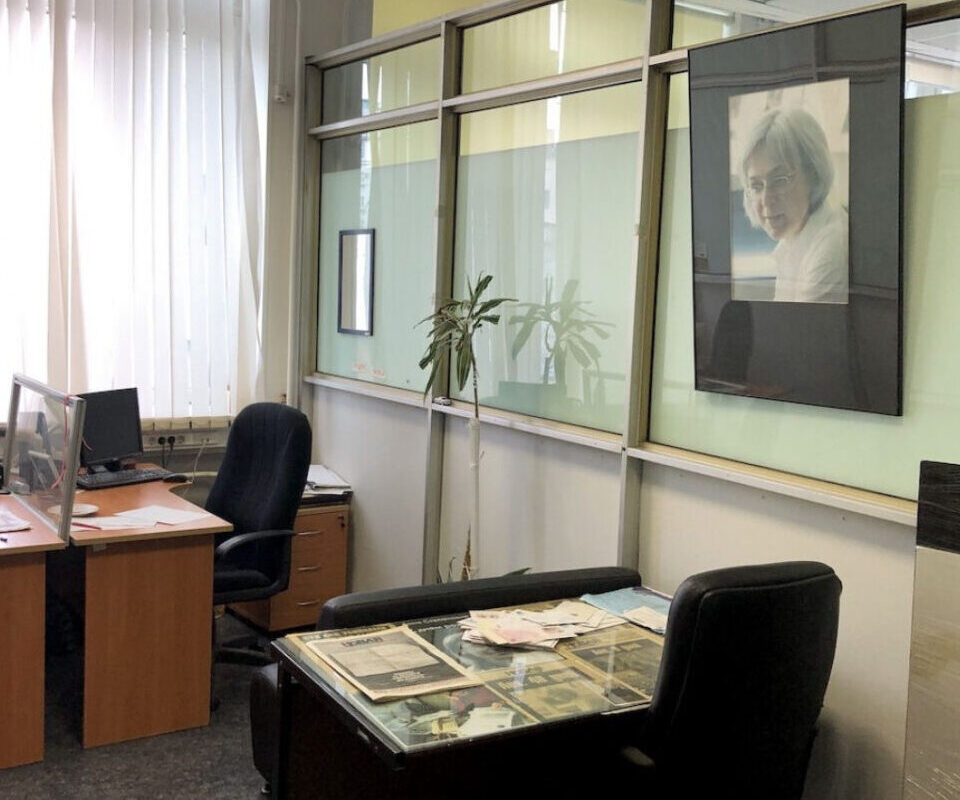
Anna Politkovskaya’s room was kept by her colleagues
A FINAL GLANCE AT CHECHNYA
Novaya Gazeta was virtually the only national publication to report regularly from Ramzan Kadyrov’s Chechnya. In 2017, reporter Yelena Milashina became the first journalist to report that Chechen security forces were abducting men suspected of being gay and torturing them in secret locations. Kadyrov denied the reports, describing the reporters as ‘devils’; Milashina, who received death threats, was forced to leave the country for a time.
The threats were not merely empty words. In 2020, Milashina was beaten in the lobby of a hotel in Grozny. In 2023, she and her lawyer, Aleksandr Nemov, were stopped on the road by armed men; her fingers were broken, her hair was shaved off, and Nemov was stabbed.
THE NOBEL PRIZE PROVIDED LIMITED PROTECTION
In 2021, the Nobel Peace Prize was awarded to Muratov alongside the Filipino journalist Maria Ressa. Muratov dedicated the prize to his murdered colleagues and, in 2022, put his medal up for auction to benefit Ukrainian refugee children. It was often said that the Nobel Prize served as a shield, enabling Muratov to remain in Russia after 2022. But this shield was limited: in 2022, Muratov was attacked on a train when red paint was poured over him, and in 2023, he was added to the ‘foreign agent’ list.
2022: THE GREAT EXODUS OF INDEPENDENT JOURNALISTS
In 2022, alongside the invasion of Ukraine, draconian laws were passed to ‘discredit’ the army and punish ‘fake news’, making even calling the war a war a criminal offence. Novaya Gazeta suspended publication in March 2022: its licence was revoked in September, and its online registration was cancelled by the end of the year. Some of its staff set up Novaya Gazeta Europe, an independent publication based in Riga; this publication has not been affected by the closure.
Novaya was not alone. The radio station Ekho Moskvy, which maintained its critical stance despite being majority-owned by Gazprom’s media arm, Gazprom-Media, was taken off air in March 2022 and shut down by a decision of the board of directors under Gazprom-Media’s control.
Numerous independent publications, such as TV Dojd, Meduza and The Insider, were designated as ‘foreign agents’ or ‘undesirable organisations’; Riga, Tbilisi, Berlin and Amsterdam became new hubs for the Russian independent press.
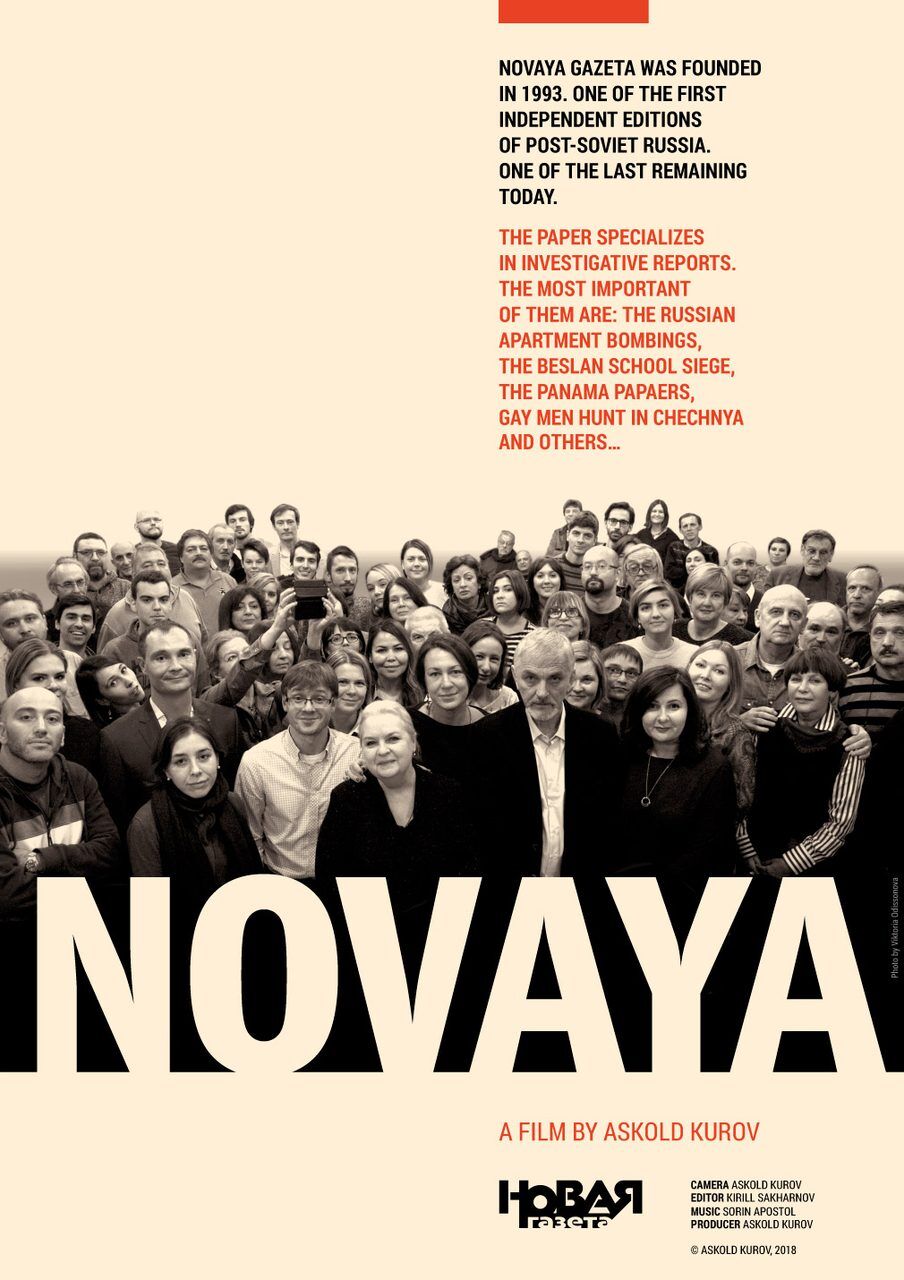
The story of the newspaper was turned into a documentary by director Askold Kurov
THOSE WHO REMAINED FACED PRISON SENTENCES
For those who remained in the country, the price was heavy prison sentences. Former defence correspondent Ivan Safronov was sentenced to 22 years for “treason”. Wall Street Journal correspondent Evan Gershkovich and RFE/RL journalist Alsu Kurmasheva were imprisoned on espionage charges; they were released in 2024 as part of a prisoner exchange in Turkey. In April 2025, four journalists on trial on allegations of links to Navalny’s foundation were each sentenced to five and a half years’ imprisonment in a closed-door hearing. In RSF’s 2026 index, Russia ranks 172nd out of 180 countries; there are 48 journalists currently held in Russian prisons.
Even the events of the week preceding the closing statement are enough to illustrate the trend. On 1 November, Russia’s withdrawal from the European Convention for the Prevention of Torture came into force; independent international monitoring of the country’s prisons and detention centres came to an end. On 2 November, the founder of The Insider, Roman Dobrokhotov, was sentenced in absentia to 5.5 years’ imprisonment on charges of ‘unwanted organisation’ activity. Meanwhile, half of the journalists at the Barents Observer, which broadcasts from Norway, are on Russia’s wanted list. In Russia, journalism is now becoming a dangerous activity not only to practise but also to read.
Novaya Gazeta declared, “We will turn off the lights.” Yet for 33 years, this newspaper has been the light shone on every place the Kremlin wanted to keep in the dark: the secret detention centres in Chechnya, the prisons, the first weeks of the war. Withdrawing from monitoring torture, imprisoning exiled journalists and closing down the last independent newspaper all serve the same aim: a country where no one can look inside.
But the story does not end in darkness. A plaque in honour of Politkovskaya hangs on the wall of the building the newspaper has vacated; more than 1,500 Russian journalists, from Riga to Berlin, continue to work in exile. Readers in Turkey, where journalists carry on reporting in court corridors and amidst the ruins of closed-down newspapers, know this better than anyone. The light in Moscow went out on 9 November, but the lights kindled by Novaya Gazeta will outlive those who seek to extinguish them by far.